
Variation management
Every variation captured, chased and paid for.
Change happens on site in seconds, and the record of it is too often made in the office weeks later, if at all. VariationFlow closes that gap for specialist subcontractors: the change is captured where it happens, submitted for instruction, tracked against your contract’s own clocks and recovered with the evidence behind it.
Site capture, the register and the audit trail come with every plan, the free one included. The NEC and JCT clocks, payment applications and deadline alerts come with the VariationFlow plan, £200 a month + VAT.
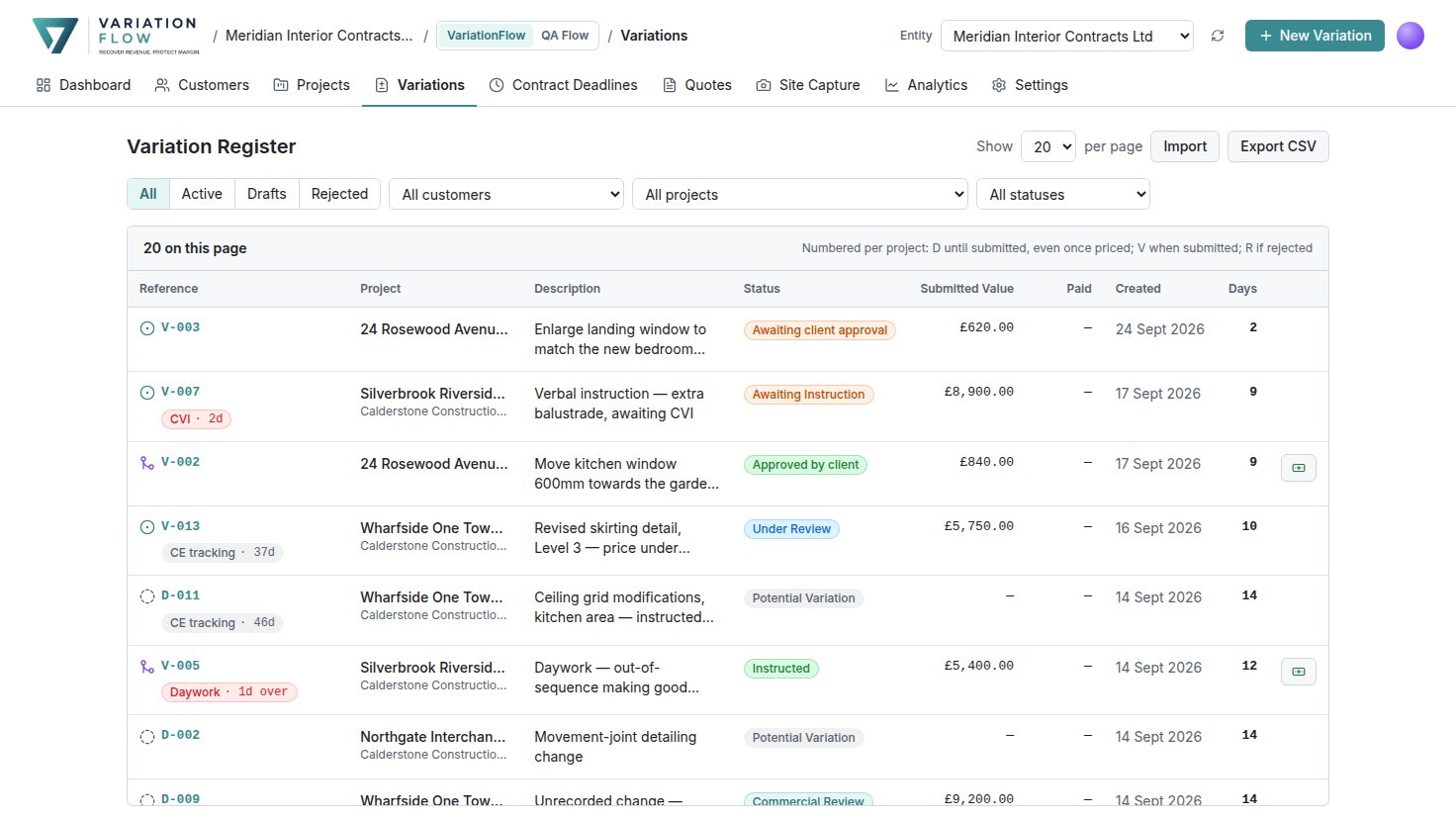
Sample figures from the VariationFlow demo company.
45 seconds: from “we’ll square it up later” to priced and chased.
Four steps. Nothing slips.
One job: every variation captured, evidenced and recovered before the contract turns it into a write-off.
STEP 1
Capture
On site, in about a minute: what changed, who asked for it and their signature, photos, a voice note and the location. With no signal the app keeps the capture and sends it when coverage returns, with the time it was taken.
STEP 2
Submit
The QS prices it and sends it to the main contractor for instruction: an email with a review link they can answer without an account. The variation takes its V reference and its days outstanding start.
STEP 3
Track
Amber at 28 days outstanding and red at 42. On NEC4 subcontract and JCT projects each variation carries its contract clocks, and Contract Deadlines lists every one, most urgent first.
STEP 4
Recover
Instructed and completed variations go into the monthly payment application, and payments are recorded against them. If it comes to a dispute, the audit PDF and the evidence pack carry the record.
The same job, with and without it
Without VariationFlow
- Evidence scattered across personal phones and message threads
- Instructions given on site with nothing in writing
- Variations written up weeks late, if at all
- No warning before a contract deadline passes
- The whole register in one QS’s spreadsheet
- A final account argued from memory
With VariationFlow
- Photos, a voice note, the location and a signature, captured on site in about a minute
- Work started before an instruction flagged from site, so the office knows to confirm it
- A dated, referenced record from the moment of capture
- Contract clocks on every variation, with an alert as they run down
- One register the whole commercial team can see
- An audit PDF and an evidence pack for any variation, with its full history
Every leak, closed, point by point
The same few failures lose variations on job after job. Here is what VariationFlow does about each one.
Why variations go unpaid, in full
The problem
Evidence on personal phones
What VariationFlow does
The app records photos, a voice note, the location and the signature of whoever asked for the work at the point of instruction, with or without signal. Each file’s SHA-256 fingerprint is kept, and the capture keeps the time it was taken, not the time it reached the office.
The problem
Late or missing submissions
What VariationFlow does
A priced variation goes to the main contractor in one step, and its days outstanding count from that moment: amber at 28, red at 42, with an email to the QS assigned to the project as it ages.
The problem
No written submission record
What VariationFlow does
Each submission is an email headed Variation for Instruction, with a review link the main contractor can answer without an account. Agreed, countered, under review or rejected, the answer goes on the variation’s audit trail with its time.
The problem
Knowledge locked in one person
What VariationFlow does
One register for the whole commercial team, every variation with its project reference and stage, and a Revenue Dashboard that shows what is submitted, instructed, outstanding and recovered without asking the QS.
The problem
The compensation event window
What VariationFlow does
On an NEC4 subcontract project each variation carries its clause 61.3 bar, counted from the date you became aware of the event or else the capture date, with your Z clause period in its place where you record one. Marking the event notified records the date.
The problem
Evidence for an adjudication
What VariationFlow does
The audit PDF lays out a variation, its evidence and its hash-chained history, and says whether the chain verified when it was exported. The evidence pack ZIP carries the original files with their fingerprints, for a main contractor’s portal.
The contractual stakes
Why timing is the whole game
The contracts do not ask whether the work was real. They ask whether you notified, evidenced and claimed it correctly, and on time. These are the clauses that decide it.
NEC4 Engineering and Construction Subcontract
NEC4 subcontract: compensation events and the timescale trap
On an NEC4 job a specialist works under the Engineering and Construction Subcontract, and the other side is the Contractor, not the Project Manager. Its compensation event procedure is strict: miss the notification period and the time and money are lost however genuine the event, and miss the quotation period and the Contractor assesses the event instead. Every period below is the subcontract’s own.
Notify a compensation event within seven weeks
If something has happened that you believe is a compensation event and the Contractor has not notified it, you notify it within seven weeks of becoming aware of it. Miss that and your Prices, your Subcontract Completion Date and any Key Date stay as they are, however genuine the event. The subcontract period is shorter than the main contract’s eight weeks on purpose: the Contractor has to take your notification and pass the same event up the chain inside its own. Z clauses often shorten your period further, so read the schedule of amendments.
Early warnings run both ways
You and the Contractor each give an early warning as soon as either of you becomes aware of a matter that could increase the Prices, delay completion or a Key Date, or impair the works in use. An early warning is not a compensation event notification and does not stop the clock above. But if the Contractor decides you did not give one an experienced subcontractor could have given, and tells you so when it instructs you to quote, the event is assessed as if you had, and cost an early warning would have avoided stays with you.
Quote within two weeks; the reply is due within four weeks
Once the Contractor instructs you to submit a quotation, it is due within two weeks. The Contractor then has four weeks to reply. If it does not, notify the failure, and if the silence runs on for a further three weeks your quotation is treated as accepted. These are the subcontract’s periods, and none of them is the main contract’s.
When the Contractor assesses the event instead
If your quotation is not in on time, or the Contractor decides you have not assessed the event correctly and does not ask you for a revised quotation, the Contractor makes its own assessment, and it will be its view of your cost rather than yours. The defence is a quotation inside the period, with the dates, the costs and the effect on the programme recorded at the time behind it.
VariationFlow runs these on every NEC4 subcontract project: the 61.3 bar on each variation, from the date you became aware of the event or else the capture date, and the quotation tracker through 62.3 and 62.6.
JCT Standard Building Contract and Design and Build
JCT: the main contract’s clauses, and your sub-contract’s periods
On a JCT job a specialist signs a JCT sub-contract, and VariationFlow has no sub-contract form in its list yet. So the clause numbers below are the main contract’s, which your sub-contract mirrors under numbers and periods of its own. Where a period matters, VariationFlow either asks for yours or says whose it is.
Instructions given orally
On the main contract an instruction given otherwise than in writing does not take effect straight away. It is confirmed in writing within 7 days, and if there is no dissent within a further 7 days of receipt, it takes effect as an instruction. Work built on an oral instruction nobody confirmed is work you will struggle to be paid for. When site switches on “Work has proceeded” on a capture, VariationFlow starts the confirmation clock on a Standard Building Contract or Design and Build project. The 7 days are the main contract’s, so check your sub-contract’s own.
Loss and expense: notify when it becomes apparent
Under the main contract, loss and expense turns on a notice given as soon as the likely effect of a matter on progress becomes, or should have become, reasonably apparent, followed by an initial assessment and the information the other side reasonably requires. A late notice is the first thing the other side will point to. Each JCT variation in VariationFlow carries a notices panel for loss and expense, extension of time and the daywork voucher, so the date each notice went is on the record. The clause numbers are Design and Build’s.
Payment: your periods, not the main contract’s
Whether a pay-less notice was in time depends on the due date and the final date for payment, and a JCT sub-contract sets both later than the main contract does. So on a JCT project VariationFlow asks for your sub-contract’s own payment periods, and until all three are recorded it gives no verdict on whether a pay-less notice was in time and puts no final date in a late-payment letter.
Adjudication: a decision in 28 days
The Construction Act lets either party refer a dispute to adjudication at any time, and the adjudicator must reach a decision within 28 days of the referral unless that is extended. In a timetable that short, the record made at the time does the arguing: the dated submission, the instruction, the photographs and the name of whoever asked for the work. VariationFlow’s audit PDF carries a variation, its evidence and its full history, with a line saying whether the hash chain verified when it was exported.
General information, not legal advice. Clause numbers and periods are those of the published standard forms; your own contract, and any amendments to it, govern.
Watch the full walkthrough
Every stage, end to end, from a capture on site to the money landing. Real screens, no slides.
Questions
- What is VariationFlow?
- VariationFlow is variation, payment and commercial control software for UK specialist subcontractors. Site crews capture each change on their phones; the office prices it, submits it for instruction and tracks the NEC4 subcontract and JCT clocks against it; and the CVR sets cost against value on every job.
- Who is VariationFlow for?
- Specialist subcontractors working under main contractors in the UK: fit-out, dry lining, flooring, electrical, mechanical, fire protection, roofing and groundworks among them. Builders working directly for homeowners have a plan of their own, Builder.
- Does the app work without signal?
- Yes. The iPhone and Android app captures photos, a voice note, the location and the requester’s signature with or without signal, and sends the variation when the phone is back online.
- Which contracts and deadlines does it track?
- On the NEC4 subcontract, the compensation event notification bar under clause 61.3, with room for a Z clause that shortens it, and the quotation periods under clauses 62.3 and 62.6. On JCT Standard Building and Design and Build, the confirmation of a verbal instruction. And the Construction Act payment dates on every valuation.
- What happens to a variation nobody answers?
- It ages on the register from the moment it is submitted: amber at 28 days outstanding and red at 42, and on the VariationFlow plan an email goes to the QS assigned to the project as it ages. The main contractor reviews each submission from a link, with no account needed.
- How much does VariationFlow cost?
- It is free for your first job: 1 project and 2 users, no card. The VariationFlow plan is £200 a month + VAT with unlimited users, and VariationFlow + QA Flow is £400 a month + VAT. Paid plans have a 6-month minimum term, and paying for the year takes 20% off.
Read next
Why variations go unpaid
The anatomy of a lost variation, the five causes, and why the leak lands hardest on specialist subcontractors.
NEC4 compensation events
What counts, who notifies, the 61.3 bar and how deemed acceptance works, on the subcontract and the main contract.
The contract deadlines guide
How VariationFlow counts the payment dates, runs the NEC4 subcontract clocks and handles a JCT project.
Stop losing money you have already earned
See how VariationFlow captures, tracks and recovers every variation, in a 20-minute demo built around your own contracts.